
Phantasm
Late '70s horror dates surprisingly well.
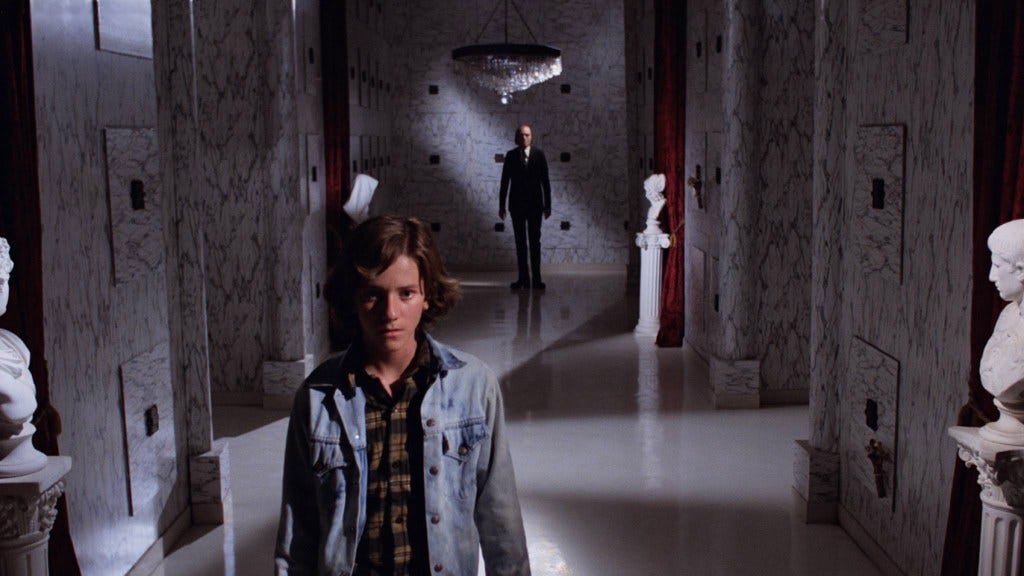
Male puberty is a nightmare in Don Coscarelli’s Phantasm (1979), one of the most unique and enduring creations of the late-’70s/1980s horror craze. Made for about $300,000 with a mostly unprofessional cast and crew (including Coscarelli’s dad, who acted as producer, and his mom, who did some of the special effects, costumes, and makeup), this is one of the best examples of the theory that horror is an ideal genre for up-and-coming filmmakers, allowing maximum impact with limited resources.
It follows a pubescent boy, Mike (Michael Baldwin), who’s had a rough go of it recently: his parents died only a few years ago, and now his beloved older brother, Jody (Bill Thornbury), is about to leave home, abandoning Mike. Jody’s friend Tommy (Bill Cone) has just died in what is rumored to be a suicide, though the bafflingly direct first scene of the movie shows us what really happened: Tommy has sex in a cemetery with an alluring “Lady in Lavender” (Kathy Lester), who then stabs Tommy to death and transforms into the specter of a tall, pale, gray-haired man. This “Tall Man” (Angus Scrimm) doubles as the undertaker at ominous Morningside cemetery, where Tommy is buried; Mike and Jody soon discover strange goings-on there, including an army of aggressive dwarves in black robes and a flying orb with vicious appendages.
The plot of Phantasm isn’t too difficult to parse out (even when it gets increasingly convoluted near the end, complete with a vision of a distant planet with arid terrain and blood-red skies), but its storytelling is fluid and dreamlike. Certain strange glimpses and seemingly minor details recur throughout the movie, and it’s never exactly clear what’s real and what’s a nightmare. Illogical events (like the infamous scene in which we first see what that flying orb is really meant for) make total sense when they play out in the movie. There’s a middle stretch in which we’re introduced to several new characters who behave in inane, self-destructive ways. Such inconsistencies are right at home in the horror genre, which (when done well) only becomes more effective the more incomprehensible it gets. This spontaneous style is partly a result of the long production process (Coscarelli initially had over three hours of footage, shot over the course of several years, which was edited down to less than 90 minutes), but other horror filmmakers would have a tough time duplicating Phantasm’s oneiric spell if they tried.
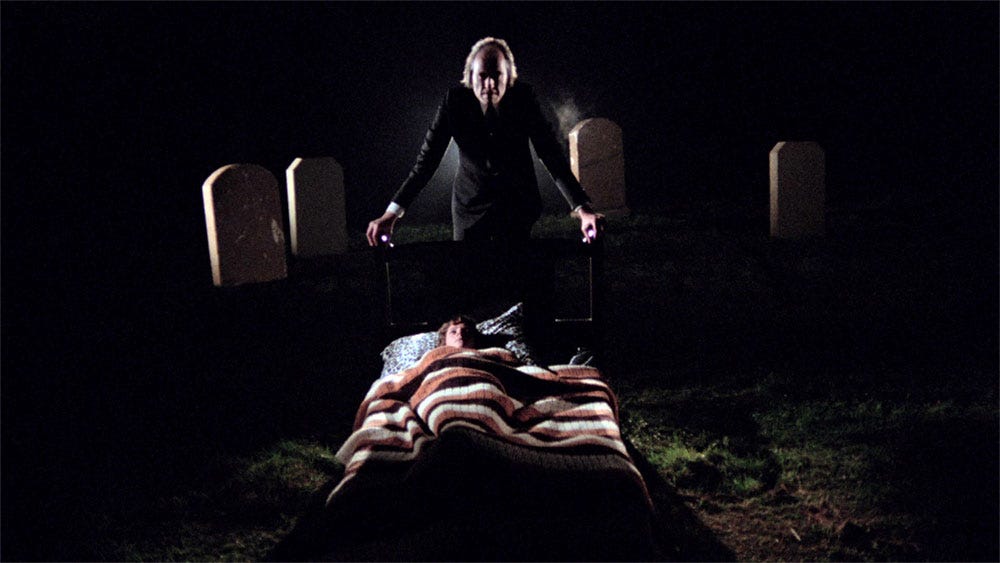
Indeed, this is a well-made picture with legitimate craft and artistry. Nighttime scenes are well-shot in a way that almost no low-budget horror movies are (watch practically any Friday the 13th movie for an example). The sets are just slightly surreal, a little too perfectly symmetrical (the mausoleum set, for example, was constructed of plywood and paper, though it looks convincingly marble), or wonderfully dingy in their late-’70s residential monotony. Coscarelli (who served as editor and cinematographer) has a firm grasp on pacing, rhythm, and visual effects like slow-motion and double exposure; see the scene in which Mike spies the Tall Man walking down the sidewalk in slow-motion, only for the Tall Man to stop in his tracks, stare Mike down, and bask in the steam emanating from an ice cream truck’s freezer. There’s even a car chase of sorts! Coscarelli had made two (non-horror) features before this, but even so, the level of stylistic care in Phantasm is unexpected; at its best, it rivals the gonzo visions of Don’t Look Now (1973) and the constantly building dread of Halloween (1978).
Maybe even more impressive: Phantasm has more on its mind than simply cheap thrills. This is ultimately a coming-of-age story, following Mike as he ventures through the frightening realm of puberty. It’s a story of loss and mourning first and foremost: Mike is still dealing with the loss of his parents when he discovers that his brother will soon abandon him. We see Mike visit a neighborhood witch/oracle in an attempt to deal with his trauma and regain some kind of control over his life. (It’s made clear that Mike has visited this figure before, making his visits to her something of a desperate bid at mental equilibrium.) Mike has also made a habit of following his brother around somewhat obsessively, spying on him from a distance as Jody has sex with the Lady in Lavender (or is it?!) in the cemetery; clearly, Mike is dealing with some overattachment issues. Even Phantasm’s greatest weakness—the lack of depth of the female characters—could be seen as a reflection of Mike’s formative age: sex and women can only be mysteries to him, unknowable but fascinating, and he’s really only comfortable being close with the men in his life (including Jody’s friend Reggie). On their own, the eerie, inexplicable chills in Phantasm would have been entertaining; but coupled with the movie’s surprising attention to Mike’s emotional turmoil, they have surprising staying power.
These neuroses and relationships are movingly conveyed by the amateur cast, who may not be masterful actors, but their ostensible flaws—stilted line readings, awkward pauses, overemphatic gestures—simply reveal the humans behind the performances. As often happens with non-professional actors, the lack of polish feels more human than what many trained actors are able to accomplish. (The villagers in Abbas Kiarostami’s Koker trilogy—Where Is the Friend’s House?, And Life Goes On, and Through the Olive Trees—are probably the best example of this.) Several scenes in Phantasm are more touching than expected simply because of the actors’ apparent vulnerability: a scene in which Mike bids farewell to Jody before he snoops in the cemetery, for example, or a late scene in which Mike and Reggie share a heart-to-heart by a raging fire. In the end, for all its surface provocations, what’s most shocking about Phantasm is how human it is.